Rouen, the Cathedral Monet Painted Some Thirty Times
In 1892 and 1893, Claude Monet set up in front of the portal of Rouen Cathedral and painted it again and again, at every hour. What he was pursuing was not the stone, but what passes over it.
14 October 2026
Three Windows Facing the Portal
Monet arrived in Rouen at the beginning of February 1892. His first two canvases show the cour d'Albane, to the northwest of the cathedral. Very quickly, he sought a vantage point facing the façade, and found one among the shopkeepers of the square.
He worked first at 31 place de la Cathédrale. Renovation work forced him to move: he then set up in the fitting room of a lingerie and fashion shop run by Fernand Lévy, in the former Bureau des Finances, now the tourist office. The last six canvases were born in Édouard Mauquit's drapery shop, at 81 rue du Grand-Pont, a building since demolished. One can picture the scene: a painter and his easels among the fittings, his nose to the window.
There were two campaigns, from February to April 1892, then from February to April 1893. The canvases were then reworked in Monet's studio in 1894, and many bear that date.
How Many Cathedrals?
The exact count varies by source. The French Wikipedia article speaks of 30 paintings, its English version of "more than thirty," and the Musée des Beaux-Arts de Rouen, which holds one, of "no fewer than twenty-eight views." The discrepancy no doubt comes down to which canvases are counted as part of the series or not; it changes nothing essential.
Because the subject does not move: it is almost always the west portal, seen close up, from different angles and at different times of day. The titles alone tell the story of the series: « Le Portail, soleil matinal » (The Portal, Morning Sun), « Le Portail, temps gris » (The Portal, Grey Weather), « Le Portail et la tour Saint-Romain, plein soleil » (The Portal and the Saint-Romain Tower, Full Sunlight).
The Light, Not the Monument
Monet was not making an architectural survey. The carved stone dissolves into a thick matter of paint that changes color with the hour and with the weather. The monument stays, the hour changes, and it is the hour he paints.
Georges Clemenceau put it better than anyone: « Aussi longtemps que le soleil sera sur elle, il y aura autant de manières d'être de la cathédrale de Rouen que l'homme pourra faire de divisions dans le temps. » [As long as the sun shines on it, Rouen Cathedral will have as many ways of being as man can make divisions of time.] In other words, the series could never end. Monet, for his part, chose to stop.
May 1895, at Durand-Ruel's
In May 1895, Monet chose twenty of his cathedrals and exhibited them in Paris at his dealer's, Durand-Ruel. He sold eight before the exhibition closed. Degas, Cézanne, Pissarro and Renoir came to see them, and admired them.
On 20 May 1895, Clemenceau published an article in his newspaper, La Justice, titled « Révolution de cathédrales » (Revolution of Cathedrals). In it, he spoke of a revolution carried out without a single shot fired, and urged the President of the Republic, Félix Faure, to buy the entire series for France, so that it would not be scattered. He was not heeded: the canvases are today found in several museums, including Orsay, the Metropolitan Museum in New York, the National Gallery in Washington, and the Musée des Beaux-Arts de Rouen. The article did, however, seal a friendship between the two men, which would last until Monet's death in 1926.
Another Cathedral, Seen from the Street
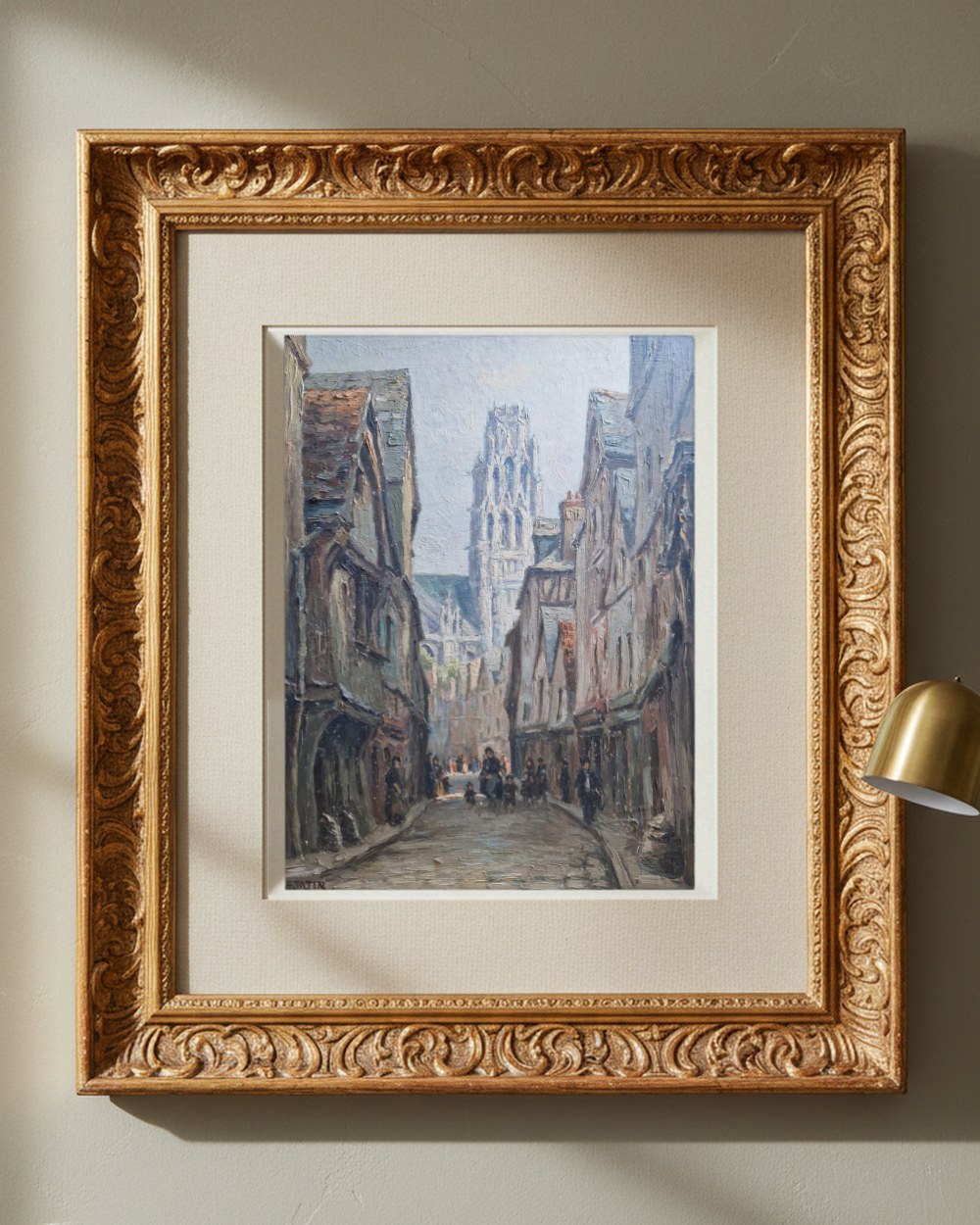
Our catalogue presents a « Vue de la cathédrale de Rouen » (View of Rouen Cathedral) signed Émile Tatin, an oil on panel that looks at the same monument quite differently. Here, no close-up portal: we are at the end of a narrow street lined with half-timbered houses. Passers-by walk on the cobblestones, and the cathedral tower rises above the rooftops.
Monet pressed his gaze to the façade until he dissolved it into light. Tatin puts it back in its place, in the city, as seen by someone who lives there or passes through: a familiar landmark at the end of the street. Two ways of looking at Rouen, neither erasing the other.